
Masks of the Rabha
The dense forests of Goalpara in Assam have long been the spiritual cradle of the Rabha community, a place where ancient animistic beliefs transform raw wood into vessels for the divine. Historically, the creation of traditional Char-Gog or wooden masks was a deeply sacred ritual, strictly governed by spiritual taboos and intended solely for ceremonial dances that appeased forest deities and ancestors.
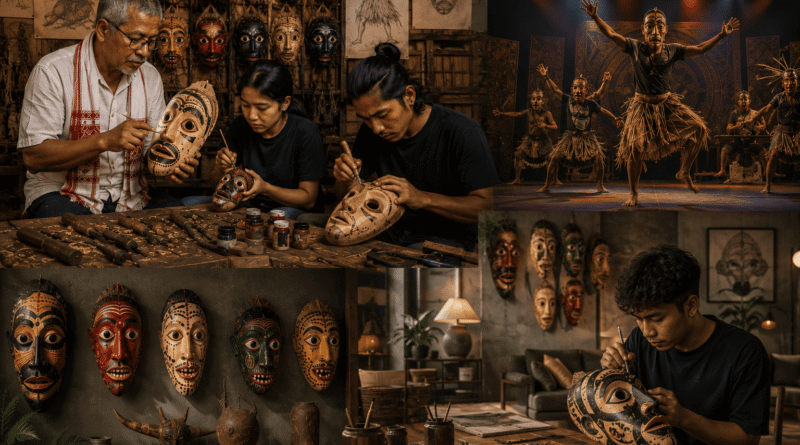
These masks were never meant to be sold, hoarded, or viewed as mere decoration; they were living spiritual extensions of community worship. Today, however, this ancient craft is finding an entirely new expression under the guidance of famed master craftsman Shanti Ram Rabha. In a quiet cultural rebellion, he is actively teaching Gen Z artisans to carve these traditional masks not for secluded forest rituals, but for the avant-garde stages of high-concept theater and contemporary interior design.This deliberate shift into the commercial art market highlights a complex, vital conversation around the commercialization of the sacred. For many purists, decoupling a ritual object from its original spiritual context risks diluting its historical meaning.
Yet, the reality on the ground presents a much more pragmatic truth: without economic viability, the specialized knowledge required to choose the right forest timber, treat the wood, and carve the intricate expressions would inevitably die out with the older generation. By repurposing these masks as high-value art installations and theatrical props, Shanti Ram Rabha is providing young Rabha youth with a sustainable livelihood deeply rooted in their own heritage. This calculated commercial survival strategy proves that commodification does not have to mean degradation; instead, it can act as the very shield that saves an ancient craft from absolute extinction.Watching a young artisan adapt these ancient carving techniques for a global market reveals how the boundaries of contemporary art are being expanded by indigenous hands. The fearsome expressions of forest spirits, once illuminated only by the flicker of ritual bonfires, are now being recontextualized under the sharp track-lighting of urban art galleries and minimalist homes.
This generation of young carvers is learning to maintain the technical rigor of their ancestors while experimenting with scales, finishes, and presentations that appeal to global collectors. They are actively asserting that their community’s heritage is not a fragile artifact that must be kept hidden in the dark to remain pure, but a robust, living design philosophy that can hold its own on the international stage.This artistic migration beautifully captures the evolution from a reclusive, forest-based past to a highly connected, modern creative future. The transformation of the Rabha mask does not erase its spiritual origin; rather, it allows the stories of the Goalpara forests to travel across geographical and cultural borders.
By teaching the youth to navigate this delicate balance between sacred tradition and modern commerce, the community is ensuring that the generational chain of knowledge remains unbroken. They stand as a testament to the fact that for an ancient culture to survive a changing world, it must know exactly how to step out of the isolation of the past and carve its own permanent space within the global creative economy.