ASMITA U-16: The Future of Women’s Sports
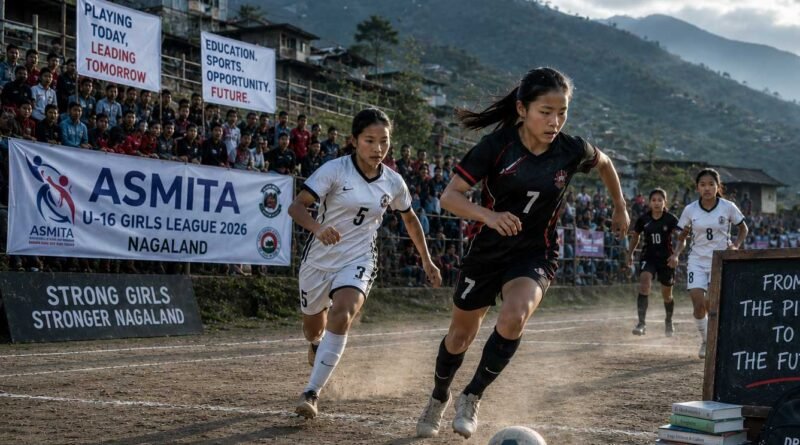
The dust kicking up from the makeshift football pitches in the remote districts of Nagaland is carrying more than just the competitive spirit of a game; it is carrying the academic and life aspirations of a generation. Following the 2026 ASMITA U-16 Girls League, the conversation around women’s sports in the state has rapidly shifted from mere recreation to a powerful mechanism for survival and survival-driven ambition.
Profiling three young athletes from the furthest corners of Nagaland reveals that the football field has become a literal socioeconomic launchpad. For these girls, every training session and local match is viewed as a high-stakes trial, a pathway to securing sports quotas that can bridge the immense geographical and financial distance between their home villages and a college education in Delhi.Using sports as a vehicle for social mobility is a well-documented phenomenon, but its necessity in the contemporary Northeast carries distinct structural weight. In regions where higher educational infrastructure remains centralized in distant urban hubs and financial constraints often limit a family's capacity to send daughters to mainland universities, athletic excellence offers a rare, meritocratic escape hatch.
The ASMITA U-16 league acts as a vital scouting ground, transforming individual talent into tangible institutional opportunities. By focusing on the personal narratives of these three young players, the broader, often abstract political discussions around regional development and national integration are humanized through the sheer grit of teenage athletes determined to rewrite their futures through a pair of football studs.This modern athletic migration highlights an evolving paradigm where young women from indigenous communities are actively expanding their arenas of influence. Historically, the journey from a remote Naga village to the competitive academic ecosystem of the national capital was fraught with systemic barriers, cultural alienation, and economic hurdles.
Today, these young footballers are dismantling those barriers with their performance on the turf, proving that their athletic discipline makes them formidable contenders for national scholarship programs. They are redefining the archetype of the student-athlete in India, showing that the physical endurance built on mountain terrains can directly translate into intellectual mobility and institutional presence in the country's top universities.This quiet revolution on the pitch illustrates the profound shift from localized community sports to national-level engagement. The trajectory of these three young athletes does not diminish their ties to their roots; instead, it positions them as ambassadresses of their communities on a grander stage.
By treating the football field as a space of strategic opportunity rather than just leisure, they are providing a progressive blueprint for youth empowerment across the hill states. They stand as a powerful testament to a changing reality where the distance between a village playground and a national stadium is being bridged, one match at a time, by young women who refuse to let their geography dictate the boundaries of their potential.