The Matriarchs of the Market
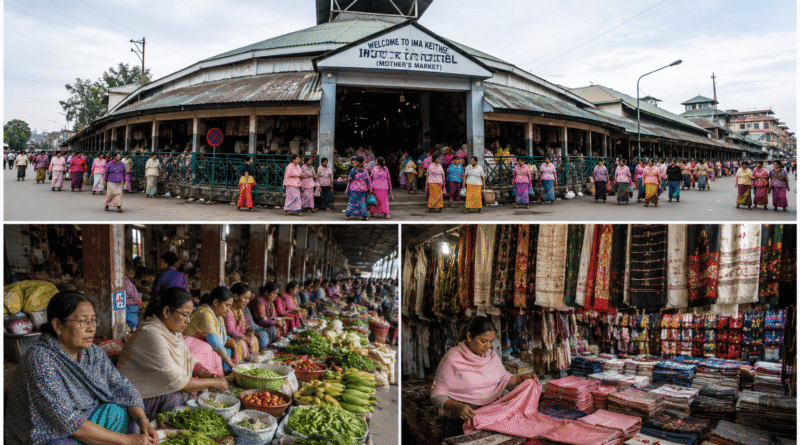
The bustling pathways of Ima Keithel, the historic Mother’s Market in the heart of Imphal, have echoed with the sounds of trade, politics, and resilience for over five centuries. As the largest all-women-run market in the world, its stalls have traditionally been passed down through generations of married women, serving as both an economic lifeline and a fierce political assembly point for Manipur.
Historically, these women—the Imas—did not just sell local textiles, dried fish, and fresh produce; they acted as the moral and social conscience of the state, famously standing at the forefront of historic anti-colonial agitations.
Yet, while the market is deeply revered as a monument to traditional matriarchy, it is far from a stagnant relic of the past. Entering this sprawling commercial hub reveals a striking digital evolution, where the ancient rhythms of tribal and Meitei trade have seamlessly merged with the cashless economy.
The image of an elderly woman wrapped in a traditional phanek, sitting cross-legged beneath a canopy of handwoven shawls while casually gesturing toward a dynamic QR code, encapsulates the modern reality of Ima Keithel. Confronted by the rapid digitization of commerce, a shifting national financial landscape, and the disruptive economic cycles of recent years, the Imas did not retreat into isolation.
Instead, they weaponized modern financial technology to fortify their ancient trades. Octogenarian matriarchs who once calculated profits purely through memory and physical cash ledger books now navigate Unified Payments Interface systems and mobile banking apps with practiced ease. This organic adoption of digital wallets and instant bank transfers has eliminated cash-flow friction, minimized local credit dependencies, and allowed these traditional vendors to keep pace with an increasingly digitized consumer base.Beyond localized digital payments, the market is undergoing an even deeper infrastructural transformation through early-stage e-commerce integration. A tech-literate generation of younger relatives and local startups is partnering with the Imas to bridge the physical stalls of Imphal with global supply chains.
Hand-loomed Meitei garments, rare local ginger varieties, and organic bamboo crafts are being photographed, cataloged, and shipped directly from the market floor to urban centers across India and international markets.
This shift challenges the conventional global corporate narrative that treats traditional, indigenous markets as obsolete systems destined to be replaced by corporate retail conglomerates. Ima Keithel proves that traditional matriarchy is not an antiquated social hierarchy but a highly adaptive, formidable economic force capable of dictating its own terms in a tech-driven marketplace.This transition defines the essence of a living cultural bridge, where a 500-year-old socioeconomic legacy actively absorbs the mechanics of the digital era to ensure its own long-term survival. The evolution occurring on the market floor does not dilute the historical or political weight of the Imas; rather, it amplifies their reach and secures their financial independence against modern market pressures.
By embracing smartphones and digital transactions without compromising their traditional community-first governance model, these women are demonstrating that true preservation requires strategic adaptation. They stand as a powerful reminder that the future of Indigenous commerce does not lie in forced modernization from the outside but in empowering ancient institutions to build their own paths toward a sustainable, tech-integrated future.